When a lender calls in a consumer loan early, the remaining instalments are not a ready-made debt statement. A Romanian High Court ruling addresses the future interest hidden inside that total.
The number in a demand letter can be unsettling. Before looking for another loan, ask a simpler question: what does that number contain?
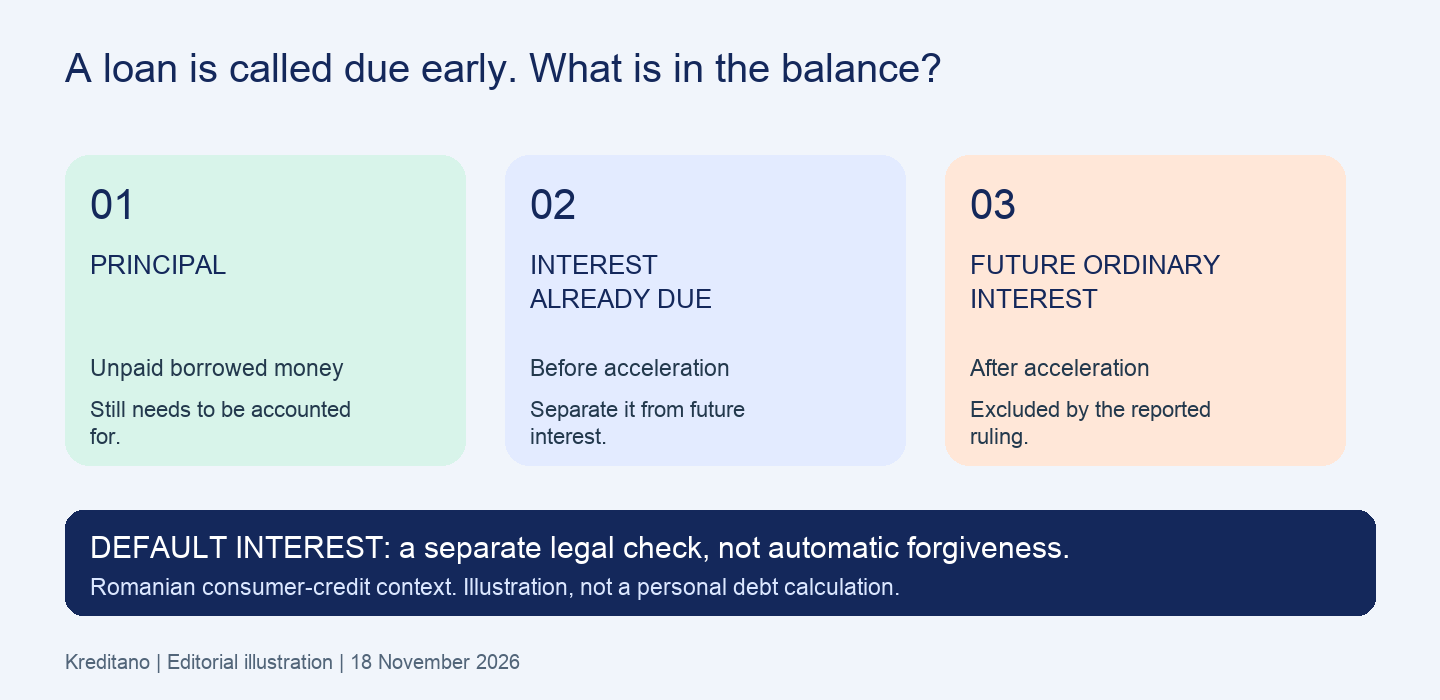
Principal, interest already due and interest scheduled for future months are different things. The distinction is central to Decision 123 of 26 October 2026, announced by Romania’s High Court of Cassation and Justice, known as the ÎCCJ.
The ruling announced by the court interprets Article 38(7) of Emergency Ordinance 50/2010 on consumer credit. It distinguishes ordinary interest already due from interest scheduled for the rest of the contract.
Future ordinary interest does not belong in the debt made immediately payable. Source and verification status.
The borrowed money does not disappear.
What is an acceleration clause?
An acceleration clause is a contract provision allowing a lender to demand repayment before the scheduled end of a loan when the relevant conditions are met. In Romanian documents, the resulting situation is usually called scadență anticipată.
It changes when repayment is demanded. It does not, on its own, prove that every item in the lender’s calculation is valid.
“Early repayment” can describe a borrower choosing to settle a loan. Acceleration concerns the lender calling the debt due.
A voluntary early-repayment calculator models a different decision; it cannot validate an accelerated debt statement.
What the ÎCCJ ruling says about future interest
The announced interpretation concerns the meaning of the debt that is due under Article 38(7). Ordinary contractual interest already due at acceleration is included; ordinary interest calculated from acceleration to the original end date is excluded.
That is a narrower finding than “banks and IFNs can no longer charge interest.”
It also does not establish that every demand letter is wrong. Your balance may already exclude future ordinary interest. Ask for the calculation and identify the disputed line before assuming a reduction applies.
The decision concerns Romanian consumer-credit rules. Do not apply this explanation automatically to business financing, a mortgage governed by another regime or a loan in another country.
Which amounts should the statement separate?
| Item | What to check |
|---|---|
| Outstanding principal | The amount borrowed that has not yet been repaid, reconciled with the payment history. |
| Ordinary interest already due | The period covered and whether it became due before acceleration. |
| Future ordinary interest | Whether the demand includes interest scheduled after acceleration, up to the original end date. |
| Default interest and other charges | The separate legal basis, rate, calculation period and relevant procedural stage. |
Article 38 distinguishes ordinary interest from default interest and contains separate rules for acceleration and enforcement. A check of those provisions is still necessary. The ruling should not be used as a blanket promise that no further amount can ever accrue. Read Article 38 on the official legislative portal.
A worked example: why the remaining instalments can mislead
This is a hypothetical breakdown, not a bank offer or a legal calculation for an individual borrower.
Suppose the records show RON 10,000 in unpaid principal, RON 300 in ordinary interest already due and RON 1,800 in future ordinary interest built into the remaining schedule.
- Adding all three produces RON 12,100.
- Removing future ordinary interest leaves RON 10,300 for those two remaining components.
- The difference is RON 1,800, not a cancellation of the RON 10,000 principal.
RON 10,300 is not necessarily the final settlement figure.
The example deliberately leaves default interest, payments not yet allocated and any separately justified costs outside the calculation. Those need their own checks. It also assumes the RON 300 was already due; accrued interest with a different due date should not be relabelled to fit the example.
What to request if your loan has been accelerated
Start with documents, not another application.
- Ask for an itemised balance. Request principal, ordinary interest, default interest and fees as separate entries, with the dates and method used for each calculation.
- Keep the acceleration notice. Note its stated effective date and how it was communicated. Keep your contract, repayment schedule and payment evidence alongside it.
- Identify future ordinary interest. Ask whether any amount covers the period after acceleration through the original end date. Request a written explanation rather than relying on a telephone summary.
- Record your objection precisely. Identify the amount and period you dispute and retain proof of the complaint. Do not assume a complaint suspends payment or enforcement deadlines.
- Get individual help where needed. If enforcement papers have arrived, have the deadlines and options checked promptly by a Romanian legal professional.
CSALB provides a route for consumers seeking to resolve disputes with banks or IFNs. Its guidance asks applicants to explain the problem clearly, specify the requested remedy and provide supporting documents. Participation and outcomes should not be treated as guaranteed. See CSALB’s application guidance.
Can you refinance a personal loan after payment problems?
Refinancing is a separate credit decision. A dispute over interest does not create a right to a new loan or guarantee acceptance by another lender.
If you are considering whether to refinance a personal loan, begin with a reliable settlement figure.
Compare APR, total repayment and closing costs. A lower instalment can still mean paying more over a longer term. Compare both schedules over the same intended repayment horizon, including any fees that must be paid before the switch.
Kreditano’s loan refinancing comparison and refinancing calculator can help you organise that comparison. They do not determine whether a debt demand is lawful or whether an application will be approved.
Do not refinance just to avoid reading the statement.
For the comparison terminology, our personal-loan guide explains costs and contract features. If you need to understand your recorded borrowing history, start with the Romanian credit bureau guide. These are supporting resources, not a promise of financing after default.
Sources and editorial checks
ÎCCJ announcement, 26 October 2026, Decision 123, file 1439/1/2026. The operative result and the court’s separate explanatory press release were checked directly. A Gazette publication reference and the full reasoned judgment have not been verified.
OUG 50/2010, Article 38, official legislative portal. The accessible version is dated 30 September 2016; the portal’s newer consolidation could not be opened during this review. No numerical default-interest cap or universal acceleration timetable is asserted here.
Romanian Civil Procedure Code, Article 521(3), official legislative portal.
CSALB: preparing a negotiation request.
Kreditano may receive a commission from some provider referrals. That does not establish eligibility or replace an individual assessment. This article explains a Romanian consumer-credit issue; it is not a decision on your contract.